Wheldrake Corncrake Reintroduction (August 2025)
Report by Michael Wajdner
How do you solve a problem like Corncrakes?
With apologies to Rogers and Hammerstein
The UK population of Corncrakes has steadily declined until, as of 2023, only 870 calling males were recorded. These are now found mainly in the Hebrides, where once they were commonplace throughout the UK’s countryside. The RSPB’s frustration in supporting the birds population might well be reflected in the line sung by Mother Abbess about ‘flibbertigibbet, will-o-the-wisp’ [Corncrake]; “How do you catch a cloud and pin it down?”
To better understand the problems facing Corncrakes and to gain an insight into the programme, Birding Group Leaders Harold and Adele Morris arranged a visit to the Lower Derwent Valley National Nature Reserve (LDVNNR). Ten birders met Senior National Reserve Manager Craig Ralston from Natural England, to hear a detailed account of the Corncrake’s life cycle, the unintended but catastrophic consequences of modern farming practices, and the critical undertakings necessary for a successful breeding and re-populating programme.
The Corncrake itself is a Blackbird sized bird, similar in stance to Coots, Moorhens and Water Rails, but superbly camouflaged in the fields. It’s summer habitat is among the hay meadows and corn fields, silently skulking among the long grasses, eating seeds and insects, darting rather than flying as it feeds and breeds. Around late August/early September it migrates to the Eastern parts of South Africa, before returning again to the UK late April/early May. The ancient practice of cutting hay in July allowed the birds to arrive, mate and breed under cover while the slow speed of cutting allowed birds to dart away from the approaching blades.
However, with early twentieth century populations growing and wartime pressures on UK farming to produce more, mechanised harvesting began. Later, the widespread adoption of silage as a feed crop saw farms cut grass late May and June while breeding was in full swing; the advent of bigger and faster tractors meant less time taken to harvest, and more significantly, no chance for the birds to out run the blades. These changes, coupled with an increasingly perilous 10,000 mile round-trip migration has decimated the numbers.
So how is the problem solved?
Firstly, Craig explained that for many years Corncrakes, initially sourced from the Hebrides, have been captive bred, in a purpose built centre in Norfolk. Captivity involves being moved between two different areas (to mimic migration movements) providing African temperatures and ‘sunshine’.
Next, following several and varied setbacks in other parts of the country, over many years, LDVNNR was identified and chosen to initiate a further attempt. Its mix of habitat, well above flood levels and, in partnership with local farms, is cut only in July leaving cover friendly margins. Given the go-ahead on 1st March 2025, Craig called on the LDVNNR volunteer team (Friends of LDV), and sponsor partners, to create 16 predator proof pens suitable for hosting separated batches of young Corncrakes.
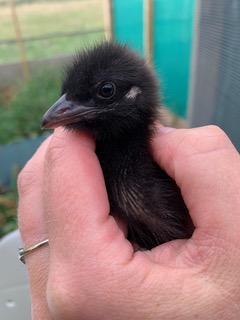
Phase one was based on the known behaviour of parent Corncrakes abandoning their offspring at 12 days old, with "junior" being left to build up body mass over the next 35 days, ready for migration. Craig would drive and collect a clutch of birds, 14 day-old, during the night so as not to unduly stress them and then release them into one of the newly built pens. He repeated the trip regularly during the breeding season, garnered around 80 birds in total.
Phase two saw feeding and monitoring of the fledglings in preparation for release and migration. The first week saw trap door feeding with high nutrition feed pellets and meal worms alongside parasite treatments in the drinking water, thereby aiding strong growth. The next two weeks see the diet altered in preparation for a more natural diet in the wild; often requiring volunteers to sweep meadows with nets to capture small insects which are then introduced to the pens for the birds to discover and pounce upon.
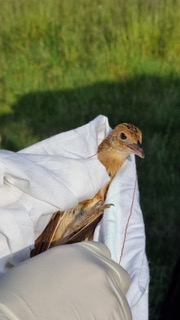
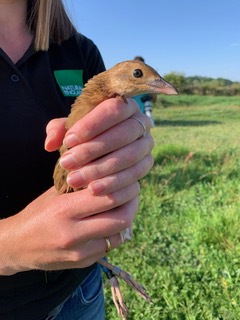
Phase three, prior to release, the birds are ringed and colour-ringed, given a veterinarian health check, DNA swabbed and (for a small sample of birds), fitted with tracking tags.
Outcome? Initial data from the tracking is encouraging. The birds roamed the margins and then set off in the darkness, around 10:30pm, for South Africa when between 41-47 days old.
Next year will reveal whether any successfully survived the trip and think of the LDVNNR as home.
Postscript
All that is left now is to hope that some of the birds return next Spring. To that end, Craig would like to hear of any findings of Corncrakes, whether hearing the call (a rasping ‘crek-crek’) or discovery of a body. Contact him on craig.ralston@naturalengland.org.uk
The programme has cost around £75,000. While individual donations, partner sponsorships and the services of the Friends of LDV have supplied much of it, further contributions are always welcomed.
If you would like to join in with the Friends of LDV, contact Craig as above..